PE Mechanical Thermal Exam Prep

In our PE Mechanical Thermal exam prep course, we cover the topics that are most likely to be on the exam and align our content with the NCEES exam specs. In this course, you will engage with live or recorded lecture videos, apply your knowledge through hands-on practice problems, and gain the confidence you need to excel on the exam. 

Choose Your Course Option

PE Mechanical Thermal OnDemand

This is the perfect option for especially busy schedules. Study at your own pace and gain access to course materials immediately upon registration.

Includes:-
    • Immediate Access to OnDemand Course
    • PE Mechanical Thermal Workbook (eBook)
    • Question Bank
    • Flashcards
    • Pass Guarantee (Monthly Subscription Excluded)

PE Mechanical Thermal Live Online

Receive the experience of studying in a live classroom with live instructor interaction anywhere, on any device with internet access. You will also have access to recordings of class lectures to refresh your knowledge on previous topics.

*Course access extends through the end of the next full month after your last class.

Includes:-
    • Access to attend Live Online class
    • PE Mechanical Thermal Workbook (eBook)
    • Question Bank
    • Flashcards
    • Pass Guarantee

Immediate Access to OnDemand Course

Get started right away

Pass Guarantee

On courses 4 months or longer

24/7 Student Support

Our dedicated team is available around the clock

The School of PE was instrumental in my passing of the Mechanical Thermal and Fluid Systems PE Exam. The School of PE kept me on a strict study schedule that helped ensure I would cover all of the material in time for the exam.

Andrew Foote

Excellent Review Course. School of PE really helped me prepare for the PE Exam. Instructors gave me good tips for the exam and tough exercises to practice through the refreshing course. I took the PE Mechanical: Thermal and Fluids Systems and I passed at the first shot! I would definitely recommend School of PE to other engineers.

Milton Pachecolay

Course Features

  • Instructor-Prepared Course Notes
    School of PE instructors generate their own notes and handouts for students to use in conjunction with course lectures. These instructor-prepared files are a student favorite: in fact, 95% of School of PE students commented that they considered these notes to be necessary to their exam preparation.
  • Lecture Videos
    Follow along with your instructor’s recorded video lectures.
  • Pass Guarantee*
    If you did not pass your exam, you may be eligible for our Pass Guarantee. For additional details, see our Pass Guarantee page. *Not applicable to monthly courses.
  • Personalized Study Plan*
    Answer a few questions about your learning priorities as well as the days and times you can study, and a personalized study plan will be generated to help keep you on track. This plan is adaptive and can be adjusted to reflect your changing schedule! *Not applicable to monthly courses.
  • Instructor Connect*
    Your direct link to our teaching team. Ask unlimited questions, get clear answers and advice from the experts.* *Not applicable to monthly courses.
  • Study Anytime, Anywhere, on Any Device
    School of PE courses and resources can be accessed on any device (computer, phone, tablet, etc.) connected to the internet.
  • Discussion Forum
    Use the discussion forum in your Study Hub to share questions, answers, and information with your classmates.
  • Study Hub
    Our Study Hub is the one-stop shop for all students enrolled in a Live Online, OnDemand, or bundled course. Through this login page, you will be able to track your progress, start and stop course recordings, access study resources like flashcards, interact with your instructors and classmates, and more!

Digital Study Materials

  • Question Bank
    With our Question Bank, you can develop your test-taking skills by becoming familiar with various question formats, testing your knowledge on specific topics, working on your timing, and more.
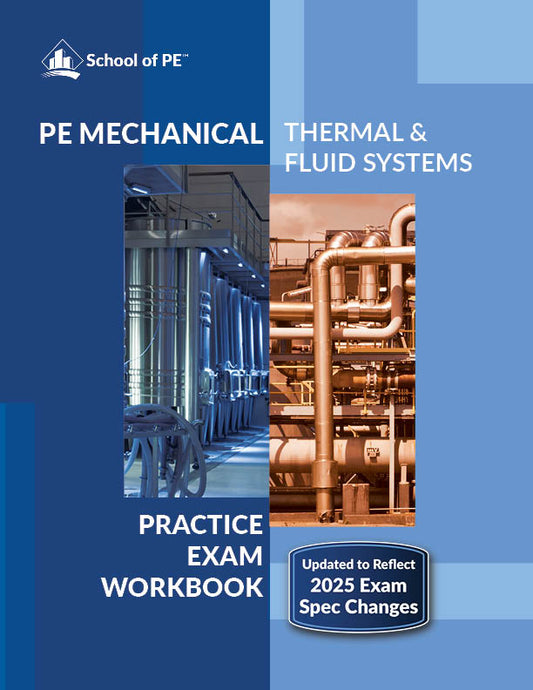
  • PE Mechanical Thermal Workbook (eBook)
    Prepare for the PE Mechanical Thermal and Fluid Systems exam with this workbook featuring 80 realistic practice problems and comprehensive solutions that reflect the new 2025 NCEES exam specs. It is designed to build your confidence by focusing on the types of questions you'll encounter on the CBT.
  • Flashcards
    Use flashcards to quiz yourself on important engineering definitions and concepts. You can even take this resource on-the-go with our Study Hub mobile app!

Why School of PE?

  • 94% Average Pass Rates
  • #1-Rated Engineering Exam Prep Courses
  • Jumpstart Your Exam Prep
    You will gain access to our Study Hub as soon as your register! OnDemand and Live Online + OnDemand Bundles will have full access to all course materials from day one. Live Online courses will have select study materials available on day one, and full course materials will be made accessible as live class sessions are completed.
  • 100,000+ Busy Professionals Helped
  • 24/7/365 Student Support

Why Enroll Today?

  • Jumpstart Your Exam Prep
    You will gain access to our Study Hub as soon as your register! OnDemand and Live Online + OnDemand Bundles will have full access to all course materials from day one. Live Online courses will have select study materials available on day one, and full course materials will be made accessible as live class sessions are completed.
  • Affirm Financing Available*
    We have teamed up with Affirm, allowing you to focus on your upcoming exam without stressing about how to pay for a review course. Register now and pay over time—it’s that simple! *Not available for monthly subscriptions.

Preview Videos

Curious? Here’s a Sneak Peek at Your Next Course

Take a Practice Quiz Now

Ready to test your knowledge and hone your exam-day skills? Try out our practice quiz for free here.

Our practice quizzes are designed to simulate the real exam environment, giving you the confidence and competence you need to pass on your first try.

Take The Practice Quiz

FAQ

What type of questions should I expect on this exam?

FE exams are made up of both multiple-choice questions and alternative item types (AITs) like multiple correct, point and click, drag and drop, and fill in the blank.

What is the difference between Live Online classes and an OnDemand course?

With Live Online classes, you receive the experience of studying in a live classroom with an instructor—everything takes place virtually. OnDemand courses consist of pre-recorded lecture videos you can watch at your convenience.

What if I don’t pass my exam?

Please check out our Pass Guarantee policy page for more information.

Can I access my course material on my mobile device or tablet?

Yes, you will be able to access your course material through our mobile app.

Is PE Mechanical Thermal and Fluids Systems the Right Choice for Your PE Preparation?

Preparing for the PE Mechanical Thermal and Fluids Systems exam often begins with understanding whether this specific discipline aligns with your background, your career path, and the depth of technical knowledge you want to strengthen. Many candidates compare different prep resources before realizing that specialized mechanical exam support offers more direct alignment with the topics they will face. School of PE's approach is designed to help engineers focus on the core principles that frequently appear on the exam while also reinforcing foundational concepts used in practice.


Some learners come from multidisciplinary environments and might already be familiar with structured study methods from other professional exams. While general study frameworks may feel familiar, the PE Mechancial Thermal and Fluids Systems discipline requires a more targeted, engineering-specific approach. This PE exam emphasizes applied problem solving, conceptual depth, and the ability to interpret real engineering scenarios, making PE Mechanical Thermal and Fluids Systems exam prep method more suitable.


Those who previously explored general exam preparation strategies typically find that a dedicated PE Mechanical Thermal and Fluids Systems study plan provides clearer alignment with exam expectations. With School of PE's structured course formats, students can pursue this path confidently while strengthening the specific competencies evaluated on exam day.

What Topics Are Covered in PE Mechanical Thermal and Fluids Systems?

The PE Mechanical Thermal and Fluids Systems exam includes a wide range of topics that reflect real engineering applications. Many learners begin by reviewing general study approaches, but this exam requires a deeper subject-specific focus. A structured PE Mechanical TFS practice problems approach helps reinforce applied problem-solving while also integrating practice methods. The core topics can be grouped into several major areas:


Basic and Applied Thermodynamics Coverage

Thermodynamics is one of the central components of the exam, and it requires a clear understanding of energy interactions, system behavior, properties, and cycles. Candidates who may be accustomed to broad preparation methods often find that mechanical thermodynamics requires more specialized calculation practice. The exam includes problems on work, heat transfer, pure substances, and the first and second laws. Using structured PE Mechanical TFS practice exam formats can help reinforce consistency in solving these questions.


Heat Transfer and Fluid Mechanics Topics

Heat transfer is explored through conduction, convection, and radiation, along with steady and transient behavior in real systems. Fluid mechanics focuses on the properties of fluids, their flow behavior, pressure relationships, internal and external flow, and calculations related to pumps and piping systems. Some students find that these engineering-specific calculations require more focused preparation. Incorporating exercises similar to NCEES PE Mechanical Thermal and Fluids Systems practice exam formats helps reinforce measurement interpretation, selection of equations, and multi-step reasoning.


Mechanical Systems Design and Analysis Themes

Mechanical systems appear in many exam sections, and they involve evaluating component performance, analyzing system interactions, and applying principles of design, safety, and efficiency. While general exam resources provide structured studying habits, mechanical systems require domain-specific familiarity with engineering constraints. Practicing problems modeled after PE Mechanical TFS practice problems formats can support skill development for interpreting diagrams, assessing system loads, and applying practical engineering judgment.

Which Type of Engineers Benefit Most from a PE Mechanical Thermal and Fluids Systems Exam Prep Course?

Mechanical professionals often find that the PE Mechanical Thermal and Fluids Systems discipline aligns closely with their daily work, especially if they regularly evaluate system behavior, energy transfer, or equipment performance. Many candidates begin strengthening their baseline knowledge through structured PE Mechanical Thermal and Fluids Systems exam prep methods, and this helps them ease into more advanced thermal and fluids concepts required for the exam. Engineers working in heating, cooling, power generation, or process environments typically gain the most direct benefit from this specialization.


Mid-career mechanical engineers sometimes explore broader preparation models to build study habits before transitioning into more technical problem-solving. Those who regularly engage with thermodynamic cycles or fluid transport systems often find that this exam discipline fits naturally with their responsibilities. In many workplaces, professionals use analytical tools frequently, and this is where questions regarding exam-approved equipment arise. Engineers commonly evaluate problem-solving strategies while reviewing topics. Before you get too far into your exam prep, it’s a good idea to know more about which calculators are allowed on exam day.


Even early career engineers who have started with general exam preparation patterns may discover that the PE Mechanical Thermal and Fluids Systems exam track offers clearer career alignment. Those who later move into power systems, HVAC, industrial equipment, or energy sectors often find this path more relevant. Many candidates continue to build familiarity with exam question structures by applying habits developed through structured PE Mechanical Thermal and Fluids Systems study plan approaches, which support long-term skill development for mechanical licensure.

Why Should You Choose the PE Mechanical Thermal and Fluids Systems Course from School of PE?

Selecting a prep provider is an important step, and many candidates compare different study approaches before deciding which format best supports their exam plan. Some learners begin with broad resources, while others turn to structured material to develop stronger study routines. School of PE's focused PE Mechanical TFS curriculum is designed to align with the technical depth and applied problem solving required for the exam. The following elements highlight why many engineers choose this course:


Experienced Instructor-Prepared Content

School of PE's instructors develop material specifically for mechanical exam candidates, focusing on depth, clarity, and practical relevance. Students appreciate the added technical precision provided here. The approach supports engineers seeking to refine core concepts while building consistency through PE Mechanical TFS practice problems.


Flexibility of OnDemand Format

The OnDemand format allows learners to study at their own pace while still accessing structured lessons. Professionals often value flexibility when transitioning to more technical exam preparation. Incorporating steady review habits can support long-term retention and application of complex topics covered in the PE Mechanical TFS practice exam simulations.


Support Tools and Resources Included

Candidates preparing for the PE Mechanical Thermal and Fluids Systems exam benefit from multiple layers of structured support, including problem-solving practice and clear explanations from the instructor team. Students often mention that the engineering specificity helps guide their study sessions.

Are There Any Prerequisites or Recommended Backgrounds to Have for the PE Mechanical Thermal and Fluids Systems Exam?

Most candidates preparing for the PE Mechanical Thermal and Fluids Systems exam come from mechanical or related engineering fields, but the discipline also attracts professionals with diverse technical backgrounds. Learners sometimes begin with structured methods to build consistency before transitioning into mechanical specific problem solving. Others draw from established routines when organizing their study schedule. While a mechanical foundation is helpful, many engineers strengthen gaps through structured coursework and guided review using a comprehensive PE Mechanical Thermal and Fluids Systems study plan.


Some prospective candidates are unsure whether their academic background fully aligns with the requirements for pursuing licensure. This is where questions about professional pathways naturally arise, and discussions often lead to topics like eligibility considerations for engineering licensure with non-traditional backgrounds, which appears as part of the broader guidance on qualification requirements. Understanding the range of acceptable backgrounds can help candidates evaluate whether additional preparation or experience may be necessary before applying for the exam.


Engineers who come from interdisciplinary roles may find that practicing concepts through repetition supports a clearer understanding of core mechanical topics. Using these methods alongside established study habits can help strengthen thermodynamics, fluid mechanics, and system analysis skills through PE Mechanical TFS practice problems. With structured preparation, many professionals from varied engineering environments become well prepared for the mechanical thermal and fluids systems discipline.

How Can You Enroll in PE Mechanical Thermal and Fluids Systems and What to Expect?

Enrollment for the PE Mechanical Thermal and Fluids Systems course is straightforward, and many learners begin by reviewing the available formats to determine which option best matches their schedule. Candidates who have used broad study resources often appreciate the structured path offered by School of PE. Others rely on familiar study habits as they transition into more specialized exam preparation. The enrollment process and the expectations that follow provide a clear path for moving into course materials and preparing for exam day:


Enrollment Process Overview

The enrollment process begins on the School of PE website, where candidates can review course details and available schedules. Students often find the layout intuitive as they select their preferred format. Many students appreciate the simplicity of navigating the course options and understanding the structure of the learning path.


Class Format and Schedule Expectations

After enrolling, students can access the OnDemand course format, which provides flexibility for learners balancing work and study commitments. Many engineers note that the structured module layout helps create efficient study routines. Learners may find that the mechanical-focused presentations clarify complex topics and support deeper subject reinforcement through PE Mechanical Thermal and Fluids Systems exam prep materials.


Next Steps After Enrollment

Once enrolled, learners can begin working through lessons, practice sessions, and problem-solving exercises. Those who started with structured study methods can smoothly apply their familiar scheduling techniques. Students may also replicate their usual review strategies while adapting to the specialized mechanical thermal and fluids systems content. As learners move through the material, they establish a consistent workflow that supports exam readiness using our comprehensive PE Mechanical Thermal and Fluids Systems practice exam simulations.